Tuesday, November 26, 2019

Some days aren't easy CW: talk of food

Image result for recovery is not linearI'm writing this post after struggling through lunch and want to just move past that, so I decided to write about it. First of all, me just wanting to push past the discomfort is me avoiding my emotions and I'm trying to sit in those. I thought this would be an interesting post because it's important to recognize the ups and downs in recovery.

I wanted sushi for lunch and had my heart set on it, but they were out of rice so I had to practice some flexibility in the moment. I got a "Mexican bowl" that had a base of lettuce, pico de gallo, cheese, guacamole, corn, and beans. I don't personally like loose corn or beans but I needed protein and a starch. I also got a root beer and a bag of chips. I finished the chips with ease. Then came the bowl. I suddenly wasn't interested in it. My appetite had gone. I started eating it and really didn't like it. I started to get anxious. I need to finish my meals. Relapse is the scariest thing in the world right now and I'm not letting myself fall back into those patterns. I got a little shaky as I do when I'm anxious, and my stomach started to flip. I told myself I needed to eat and finish this stupid meal.

I didn't finish the meal. I took a few more bites and decided to throw it away. Sometimes you have to eat things you don't like. Sometimes you just feel like you can't. I decided I'd buy some dumplings. I threw away my bowl before checking to see if there were dumplings. There were no dumplings. I got even more anxious, my backup plan had failed. The shakes and nausea increased. I got a quesadilla. These are easy for me to eat. My anxiety had taken over my stomach at this point and I felt like I was going to hurl. I sat down with my quesadilla and turned on Saturday Night Live. I finished half the quesadilla and threw out the rest.

This is an example of practicing flexibility. When someone doesn't like what they have to eat, they get something else. Even though I ate and I'm pretty sure I met all of my exchanges for this meal, I'm still really stressed. I had that voice in my head telling me I don't need to eat and to just forget about it all. That's what's scary. That voice is still there. I'm trying so hard to live without it, to shut it down every time it comes up, but it's hard and exhausting work.

Basically, even though I'm doing well in my recovery, there are still hard moments. Moments I think I need to be back in treatment, moments I'm scared someone will send me back to treatment. I'm not going back. I never want to go back, and not because it's not a fun place to be, but because I don't want my eating disorder to send me back. I hate her more than anything in the world and I look for the day I will live without that voice in my head.

Thursday, November 21, 2019

Eating Disorders in the LGBTQ+ Community

Image result for eating disorders within the LGBTQ communityIt's unfortunate but true. Eating disorders are big in the LGBTQ+ community. According to the National Eating Disorders Association, 42% of the males that have eating disorders are gay, and gay and bisexual boys are significantly more likely to restrict, purge, and/or use diet pills to control their weight. Gay males were seven times more likely binge and 12 times more likely to purge than heterosexual males. Women that identified as lesbian, bisexual, or bicurious were twice as likely to binge at least once per month in the last year than heterosexual women.

Because eating disorders are often about changing the way one's body looks, people that suffer from body dysphoria, the feeling of one's identity not alining with their body, are at a higher risk for developing an eating disorder. Trans individuals will try to change their appearance through dieting and exercise to resemble the gender they identify with.

There are a few reasons for the development of eating disorders in LGBTQ+ individuals:

  • Discrimination based on gender or sexual identity
  • Bullying because of sexual identity
  • Internalized negative beliefs
  • Unrealistic body image ideals or goals that are prevalent in LGBTQ+ cultures
  • Trauma
  • Fear of rejection
  • Psychological stress related to a disconnect between gender identity and biological sex
  • Not being accepted by friends and/or family for sexual identity
Overall, eating disorders don't discriminate. They affect each and every identity. I thought I couldn't have an eating disorder because I was masculine presenting. There's a stigma around eating disorders, but specifically around men with eating disorders. The world acts like eating disorders don't affect men. Because of this I convinced myself that I couldn't have an eating disorder because I'm not feminine. It took me a few weeks of treatment to accept that I could have an eating disorder even if I dressed like a 12-year-old boy. 

Sunday, November 17, 2019

Function of Emotions

At my treatment center, we learn a lot about emotions. One of my favorite lessons was the function of emotions. My treatment center lives by the idea that every emotion holds a function, and because of that there are no good or bad emotions, just emotions. What does this mean though? It means that your sadness is showing you something, your anger means something, your contentment is telling you something. Below is a list of emotions and what function they might tell you.

  • Anger
    • There is an injustice.
    • Something is wrong with the situation.
  • Sadness
    • Something is important to you.
    • Keeps you focused on what is important
  • Fear
    • Something is wrong
    • You're in danger
  • Anxiety
    • You need to prepare for something
    • Something is not right
  • Guilt
    • You noticed you need to fix something
  • Disgust
    • You need to be protected from something
People with eating disorders often struggle with how strongly they feel their emotions, so they turn to emotionally driven behaviors or avoidance strategies. In recovery, it is important to learn how responses to emotions are driving symptom use. 

Wednesday, November 13, 2019

Treatment Recap

Last Thursday, I discharged from treatment for the last time. I am determined to make this my last discharge. Last time I had an official discharge it was after eight weeks of intensive outpatient and I relapsed a month later. I'll lay out the timeline for you.

New Year's Eve of 2018 I had an intake in New York. They recommended I step into Intensive Outpatient (IOP) as soon as I return to Boston. For the first eight weeks of my sophomore spring semester, I walked 20 minutes to treatment and then 20 minutes back three times a week for three hours each day, not including seeing my therapist and dietician there outside of programming hours. I discharged from that level of care in March. I was in IOP for eight weeks.

After leaving, I relapsed and fell into old habits and took on new habits like calorie counting and using coffee as a hunger suppressant. In April, a therapist told me to go into residential, I said no. I had a month left of school and I wasn't willing to leave. So I entered Day Treatment Program (DTP), also known as Partial Hospitalization Program (PHP). I stayed in DTP at the Boston site until mid-May. I begged my therapist to let me stay in DTP and not send me to residential. Once my finals were over, she told me I had to go. I said no once again. I had a trip planned for the end of May I wasn't willing to give up. The compromise was that I would continue treatment in New York and then go to residential after my trip. I was in DTP there for four weeks.

In New York, I was doing a lot better. So much better that my treatment team considered not sending me to residential after a few weeks. But there is nothing for me in New York, no matter how much I try I can't find a purpose when I'm there. I begged my therapist to send me to residential because I would rather be in a residential treatment facility than in New York. In early June, I left New York City for Philadelphia. I was in DTP in New York for four weeks.

I don't like to think about my time in residential. It's not a fun summer getaway or summer camp like we would joke it was. I did really well during my first two weeks. Then my anxiety got the better of me and every other day I was either vomiting I was so anxious or having a panic attack. This went on for two weeks until I got on more medication. After my new meds kicked in, I started to do better and show a lot of progress. I got to see my family once a week at best. One thing I missed the most was my music. I had to move my room four times. I grew a lot. I was in residential for six and a half weeks.

I went back into DTP. But my anxiety got terrible again, and I was vomiting at least once a day every day for seven weeks. No doctor could tell me what was wrong with me. I ended up going to the ER, and they dismissed me and gave me medication that didn't work. While back at the New York site, I tried my best to continue my recovery while in this state of constant illness. All I wanted to do was go back to Boston and be where I feel at home. I was in DTP for four weeks this time around. I then went to the Boston site's DTP for one week.

Finally, I was back in IOP. At this point, I was exhausted from treatment. I had already done one round of IOP, two full rounds of DTP, and a stay at residential. I just wanted to be done. By my second week, I felt like if I had discharged, I would be fine. But my insurance gave me a certain number of days and my therapist wanted me to use all of them. I sat through the same group therapy sessions week after week, looking forward to the one day of art therapy I got a week. Last time I discharged from IOP I was terrified. This time I was ready. After seven weeks I discharged from IOP once again.

I spent 34 weeks of 2019 in treatment. It's not the most exciting way to spend the year. I wish I didn't have to go through all of that, but I'm glad I did. I used to have this metaphor about how recovery is a marathon. The marathon goes through the woods; you don't know the trail; you don't have a map, you've never trained, sometimes you need to walk, at one point you twisted your ankle. The finish line is there though. No matter how long it takes you to run the marathon the finish line will always be there. The finish line is so close for me. I'm at the point in the marathon where I start to run faster and harder because I see that finish line.

Signs Someone in your Life is Struggling

People that suffer from eating disorders often go without being treated. Why? Because the people in their life don't know the signs. That's what this blog is all about, recognizing the signs. For me, I didn't believe I had an eating disorder because no one told me I did. I was waiting for someone to ask if I was okay or to tell me I needed to seek help. The longer an eating disorder lives, the harder it is to recover. I want to help anyone reading this learn what to look out for.


1. Weight
If one is obsessed with weight, needs to reach a goal weight, weighs themselves regularly, etc. they may be struggling with an eating disorder. If there is a noticeable change in weight (either gain or loss) that is a sign they may be struggling as well.

2. Exercise
Working out every day no matter how they feel, if they're sick, in pain, exhausted, not in the mood to work out, that's a sign. If they are skipping events, or not seeing friends because they feel the need to work out, that's also a sign. If they're working out to compensate for something they ate or something they're going to eat, that's disordered. This is something that society has taught to be normal but it's not healthy and is, in fact, a warning sign. Becoming obsessed with fitness trackers can also become an issue and lead to harmful behavior like calorie counting (calorie counting is also a sign).

3. Needs to have control over their food
If they are uncomfortable eating out because it's not what they made, or having something they didn't plan on eating.

4. Regimented eating habits
If they only eat at certain times, or only eat what they consider "safe foods" (for me it was grilled cheese) and never eating outside of those times. If they only use a certain plate or utensil to eat that may be a sign.

5. Food rituals
Food rituals can be hard to spot sometimes. They can be as simple as eating slowly or taking small bites, or they can be more extreme like cutting up food into small pieces or mixing all of their food together. Food rituals are a big sign of eating disorders, they're used to decrease anxiety felt while eating.

6. Body checking
Body checking is often pulling the skin to check fat on the body, but it can also be weighing oneself regularly, pinching, and checking their size frequently.

7. Intermittent fasting or dieting
This is a loud sign of disordered eating. If they are going a day without eating or skipping a meal every day, that's a very clear sign. Claiming to be vegan or gluten-free may be a reason to cut out food from their diet.

Of course, this isn't a definitive list. There are more signs out there. Here are a couple links I used for this blog with more information on what to look for.
https://www.nationaleatingdisorders.org/blog/7-signs-your-friend-or-loved-one-might-be-struggling-eating-disorder
https://www.livescience.com/36205-eating-disorder-signs-symptoms-anorexia-bulimia.html
https://www.health.com/health/gallery/0,,20665980,00.html?
https://www.self.com/story/10-subtle-signs-someone-you-love-might-have-an-eating-disorder

As you read these warning signs, don't forget to check in with yourself. If you think you've been doing any of these habits, ask for help. Simmons has a great dietician that's at the health center and the counseling center has therapists on call if you need a professional to talk to. Additionally, there are multiple helplines.
(800) 931-2237
(866) 418-1207
(630) 577-1330
(505) 891-2664
(617) 558-1881

Don't be afraid to ask for help. As my dietician told me, no one regrets going into care. You can also talk to me, writing this blog has made me a lot more open about talking to people about my struggle and recovery and I'm open to talking even more.

Eating Disorders are more than Food

I know eating disorders are called eating disorders and have a lot to do with food and eating in the name alone, but oh my god it's so much more. At the program I'm in (which I choose to leave nameless) they treat eating disorders as emotional disorders because they are. Eating disorders are often ways to cope with uncomfortable emotions. It's important to note that eating disorders are not a lifestyle choice, but rather a biologically influenced medical illness.


Image result for eating disorder inspirationAccording to the National Institute of Mental Health, "research suggests a combination of genetic, biological, behavioral, psychological, and social factors can raise a person’s risk." It's not just a girl thinking she wants to be skinny. It's about people (not just girls) not knowing how to handle their emotions. If eating disorders were just about food, people wouldn't have to go through treatment to recover; they would do it on their own.

For me, the eating disorder served my depression. My eating disorder developed in a time of depression when I didn't know how to feel my feelings, so instead, I felt hungry. Jump forward to my sophomore year of college and the function of my eating disorder was the same. It was easier for me to feel hungry than feeling sad or angry or happy or anything. I got to a point where I was so physically exhausted from starving myself that I couldn't feel anything except tired. Giving into my eating disorder was so much worse than feeling my depression.

My eating disorder also helped to subside anxiety. I'm sure I'm not the only one that has felt nauseous due to anxiety. Well, when I felt that nausea I wouldn't eat. That just lowered my tolerance to feeling my anxiety which later hurt me more than it helped me.

This is all to say eating disorders are rarely about food. So when someone says "just eat" to a person struggling with an eating disorder, that's not helpful at all.

Calling out Diet Culture

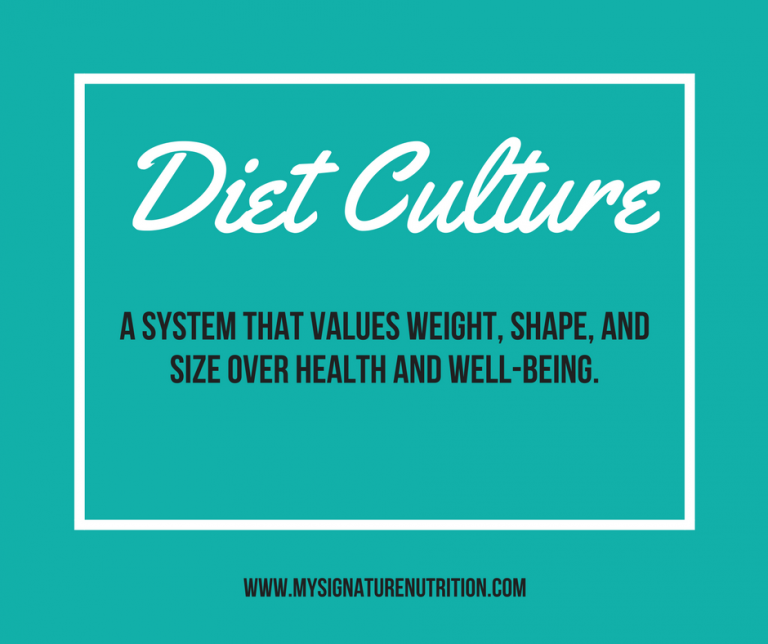
There are few things in the world that I truly despise; diet culture is one of those things. So what is diet culture? Diet culture worships thinness and equates it to health and moral virtue.

When I was in elementary school diet culture taught me that some foods were bad and some foods were good and that if I didn't see my ribs in the mirror, I was fat and to be fat was bad. In middle school, diet culture taught me that to be skinny was a good thing. In high school, diet culture taught me you had to work out even if you hated it. In college, diet culture taught me counting calories was a good habit to get into and working myself to the point of exhaustion in the gym meant I was doing it right.

In treatment, I see the effects of diet culture all the time. People have nearly died because of what diet culture says. Diet culture is society telling you you need to be under a certain weight, that fat is bad, that some foods are good and others are bad. It's weighing yourself regularly to make sure your weight doesn't go up or counting your calories in a day to make sure you don't go over a certain number. Diet culture has taken over people's lives and it is so sad to watch.

I fight diet culture every day. When I was told I had to gain weight in order to recover, I didn't want to because diet culture had taught me not to do that. Now I'm fully weight restored and I'm okay with the idea that I can continue to gain weight. When I went into treatment, I thought foods with high calories were bad and scary and would stay away from foods like pasta and cake. Now I have the understanding that all foods are good foods because no matter what they give your body energy. I used to equate the word fat with bad. Now I hate that I ever thought that. All bodies are beautiful and you can consider yourself fat and hold that with confidence.

The thing I hate most about diet culture is what it does to children. A lot of my beliefs that had to do with diet culture come from my childhood. Weight Watchers recently came out with an app for children and teens. This makes me so angry. This is teaching kids to diet, teaching them to restrict their food intake. There is an article on Weight Watchers on tips for teens to lose weight. This is ridiculous. It's so hard trying to break down that diet culture has done to society, especially children, and now Weight Watchers goes and makes an app for child weight loss. I can't stand companies like Weight Watchers.

Overall, I would kill diet culture in cold blood if I could.

Little Victories TW: Weight

Image result for weight does not define youWhen I was in residential treatment, I had many breakdowns, as one does in residential treatment. During one of these breakdowns, one counselor told me not to forget about the little victories.

Little victories are what they sound like, small accomplishments. A little victory can be getting out of bed, telling your friends how you're doing and not just saying "I'm fine," doing your homework, going to class, calling your mom, walking outside, and so much more. It's easy to forget about the little victories because we as people get so focused on the big goals that we haven't reached yet. Little victories are possibly one of the most valuable lessons I learned during my time in residential, and I'm quick to share the idea of little victories with anyone.

A little victory I'm trying to focus on is weight restoration. Weight restoration is when someone who has lost a lot of weight gains back their weight. For me, weight restoration has been a pain in the ass. It's taken 10 months for me to weight restore. The first time I was in IOP, my weight never moved. It wasn't until I was in residential that my weight started to move up. The first day I couldn't see my ribs, I cried. I was so happy that my body was trusting me again, that it was living again.

Another little victory I'm looking at is meal completion. I didn't finish one of my meals last week in program and I freaked out. The last thing that I want to do is go back to my eating disorder. Relapse scares me more than anything right now. So yeah, I didn't finish my meal, and I cried because I was so mad at myself. But my therapist reminded me the next day that I wouldn't have been so upset if I wasn't taking this seriously. That reminded me that the fact that I ordered a chipotle burrito, something I haven't done since eighth grade, was a little victory. The fact that I sat with the burrito and ate as much as I could was a victory.

Me writing this is a little victory. The intention behind this blog post is to tell people about little victories and encourage everyone to look at their own. Reading this could be a little victory. Don't sell yourself short just because you didn't get to one big thing, you're doing so many things all the time that deserve recognition.

A Day in the Night (IOP)

Related imageFor this blog, I will talk about what my night in treatment looks like and the things we discussed. First, I have a 20 to 30-minute walk to my treatment locations depending on what campus I leave from. I typically take this time to listen to music or a podcast or call my mom. When I get into treatment, it's on Boston University's campus, I have to get weighed. I won't use numbers here because that can trigger people even if they don't have eating disorders. I am on viewed weights, which means I am allowed, and encouraged, to see what my weight is. Others might be on blind weights (I was once upon a time) which means they step onto the scale backward so they don't see their weights. If my weight goes down more than a pound, I have to drink a meal supplement at dinner. Every night I step on the scale I hope and hope that my weight goes up.

Once everyone arrives it's time for Unified Treatment group, also known as UT. In UT, we cover topics like the function of emotions, avoidance, emotionally driven behaviors, motivation, and more. This night we covered what an ARC is. The ARC is an acronym for Antecedents, Response, and Consequences. Antecedents are split up between two sections, immediate and earlier. Immediate antecedents trigger an emotional reaction like getting a bad grade on a test or having your mom say something upsetting. The earlier antecedents are anything that contributes to the emotional reaction such as a childhood experience or waking up late that morning. Response is split up into three categories, thoughts, physical sensations, and urges/behaviors. Thoughts are direct quotes from your mind you have in the emotional experience. Physical sensations are what you feel in your body during the time of the emotional situation. Behaviors and urges are things you want to do and the things you do. Finally, the consequences section is also split up into two parts, short-term and long-term. Short-term consequences are what happen after the behaviors used. Long-term is something the behavior does to you.

Before we dove into what an ARC is, someone asked a simple yet packed question, how do you tell someone you're in treatment? How do you tell someone you're in treatment? At first, I didn't tell many people, just my roommate, and they already knew I had an eating disorder at that point. My first time in treatment, I was hesitant to tell anyone and waited weeks to tell my friends. Now I feel a lot more open about it. Writing this blog has helped me feel more open about talking about my eating disorder and recovery. People asked me what I did this summer, a common question to ask a student, and I would either say I worked on myself or I would give a blunt answer of I went to rehab. This opens up another question of how do you respond when someone tells you they're in treatment. If you don't respond with support, don't be surprised if you get dropped as a friend. When someone tells you they're in treatment, you should be supportive and not change your opinion of the person. Validate their struggle, but don't over exhaust it. Many people fear to tell their supports they are in treatment because they're worried what the reaction will be, and if they'll lose someone because of it. That's why it's important to just be understanding and someone that can listen.

After group therapy, we ate dinner. I am choosing not to go into detail about dinner because to be frank, it's not that interesting. It's a bunch of people with eating disorders sitting in a room eating. It's stressful and not very fun, but it's nice to be eating with people that can understand your struggle and even help you push through.

Following dinner was Multi-Family Group. This is a group my treatment center puts on twice a month that is open to the public, specifically supports of people in the program. We discussed how culture can have an impact on eating disorders. For me, queer culture helped me not believe that I had an eating disorder. Because I prefer to present myself in a masculine manner I thought I couldn't have an eating disorder. It's often seen as a feminine issue, something that only affects women so why would I have an eating disorder if  I look like a man. Other people talked about how their socio-economic status or athletic background affected their eating disorder.

Once Multi-Family group was over I ran back to my room to work on an essay for half an hour before going to practice. Working an internship, a job, being a full-time student, and sleeping is hard enough to do. Throwing 12 hours of treatment a week into that makes scheduling a nightmare. This is worth it though. Treatment is worth the six hours of sleep I get at night and the stress between classes. Because at the end of the day,  I'm doing this now so I never have to do it again.
A Student Athlete in Recovery

According to the NCAA, eating disorders are more common in female athletes than in male athletes. Because eating disorders develop or resurface during times of transition, freshmen athletes are more susceptible. The National Association of Anorexia Nervosa and Associated Disorders reported that eating disorders are 10% more common in judged sports such as gymnastics or diving than refereed sports like soccer or basketball. Certain sports like Crew require their athletes to be a certain weight to put them in a boat. The pressure to perform and look a certain way can lead to the development of eating disorders in young women.

In rugby, I don't feel this pressure to look a certain way. In fact, it's been my biggest motivator for weight restoration. But it makes things harder in recovery. Because I am undergoing weight restoration, I am supposed to be limiting my movement, but I practice three times a week and play an 80-minute game each weekend. My treatment team is willing to let me continue rugby because they know how much it motivates me in recovery.

Last week I asked my dietician if she would give the okay in letting me play the entire rugby game rather than just the half I had played the week before. The week prior, my coach pulled me out despite being perfectly fine to continue playing. I didn't want the same thing to happen again because I wanted to play.  My dietician thanked me for asking her and then, in a very nice way, told me not to play the whole game.

This past Saturday, I played the full 80 minutes of a rugby game in my favorite position of fullback. We only had 14 out of 15 people needed on the field at a time, and there was no room for me not to play the whole game. I went up to my coach before the game and told her to let me play as long as I could and that I would tell her if I needed to come out. I knew my dietician wouldn't be thrilled to know I was playing the whole game, especially after she told me not to. I decided I would have an extra snack to make up for it and that would have to be enough.

It's wild how much better I play when I'm feeding my body. In games last year, I would nearly pass out multiple times. I would get dizzy and light-headed, my blood sugar would crash and I would feel seconds away from falling over. This game though, despite being told not to play the whole game, was one of my best games. I had so much more energy than I used to. I could run and run without feeling like I would collapse. I'm so happy to be feeding my body because I finally feel like myself on the field again. Thank you rugby for giving me a reason to live my life.

Dying is Easy, Living is Harder TW: suicide

Image result for dying is easy living is hardBeing sick is easy, recovery is harder, so much harder. According to the National Association of Anorexia Nervosa and Associated Disorders, there are at least 30 million people in the U.S. that suffer from an eating disorder. Eating disorders affect all ages, genders, races, and classes. Eating disorders have the highest mortality rate of any mental illness. That's why I had an eating disorder.

I won't get too deep into how and why I held on to my eating disorder but I will take the time this blog to talk about how my eating disorder has affected my depression and my life. I used to have no drive, no motivation. I wouldn't eat because I saw no point in feeding a body that I hated so much. I've worked long and hard to move out of that headspace. It took being in Intensive Outpatient, Partial Hospitalization, Residential, then back down to Partial Hospitalization for me to realize that my body was worth feeding, I was worth feeding.

This past week I fell into that thinking trap again (thinking traps are exactly what they sound like and we talked about them earlier tonight in treatment) of I'm not worth taking care of. Having that thought again scared me, so much so it landed me in the hospital for suicidal idealization. That's not a fun thing to write in a blog for a class. But I guess it explains why I was out of class on Thursday. The thinking trap scared me so much this time around because I had worked so hard to unlearn this behavior and belief. Being back in this thought made me worry I would never get better, that all of my time spent in treatment and progress I had made was lost.

That wasn't the case. I had stopped taking my meds as prescribed (don't do that it's a bad idea) and made my mood incredibly unstable. In the past, this event would have made me spiral into a pattern of restricting, most likely skipping meals and sleeping instead of eating. But I didn't do that. I went about the next day as though I hadn't just experienced this emotionally taxing event. That's progress. That's the progress that we forget to look at. Those little victories. Leaving the hospital was a little victory, ordering breakfast while I was still there was a little victory, eating a snack before taking my nap was a little victory.

I've put so much work and effort into recovery, I'm not letting anything stop me.

Living as a Person in Recovery

Image result for eating disorder recoveryHi, my name is Audrey MacKenzie. I am a junior at Simmons University with a double major in public relations and marketing communications and media arts and a double minor in journalism and graphic design. I play rugby, work in the communications lab, and intern at Bon Me. I spent this past summer in rehab. I'm a person in recovery. This is my journey.

Writing about this scary for me, that's why I'm doing it. My eating disorder developed when I was in eighth grade and went unnoticed until my sophomore year in college. In the first semester of my sophomore year in college, I spent too much time unable to function because my blood sugar had gotten so low after not eating. I spent my time in the health center bouncing between a nurse practitioner and a dietician. I continued to play rugby and each game I feared I would pass out or not get back up after being tackled.

On New Year's Eve in 2018, I had an intake for an eating disorder clinic. They told me to start in Intensive Out-Patient (IOP) once I was back in Boston. I spent the months of January till March walking to BU's campus each Monday, Wednesday, and Thursday night to participate in group therapy and have dinner. I discharged in March and stayed discharged for about a month until I was told by a therapist I should go to residential. I had a month left of school that I wasn't willing to miss so that therapist and I compromised with Day Treatment Program (DTP) also known as Partial Hospitalization Program (PHP), a five day a week program that met for five hours a day.

I spent three weeks in DTP in Boston and four weeks in New York until I was finally sent to residential treatment. Residential treatment was in Philadelphia and I spent six and a half weeks there. I grew a lot there, and learned about myself, learned that a life without my eating disorder was a life worth living. But life there was just recovery.

Now I'm back in IOP after five weeks of DTP and I'm juggling being a student, working, and rugby with recovery. This blog is for me to talk about what it's like trying to recover while also living life. How certain things affect my recovery in positing and negative ways. And it's to teach anyone willing to learn what a person in recovery looks like, acts like, is like.